European football's governing body, UEFACompetition·UEFA, has clarified its position on hydration breaks, confirming that it has no plans to introduce mandatory, routine stoppages for the Champions LeagueCompetition·Champions League or the upcoming Euro 2028Competition·Euro 2028 tournament. The organization will continue to apply its established policy, which considers such breaks only when extreme temperatures are forecast.
Under UEFACompetition·UEFA's current regulations, cooling and drinking breaks are assessed on a case-by-case basis. Match officials are tasked with measuring pitch-side conditions, preferably using a digital wet bulb globe temperature (WBGT) thermometer. Mandatory stoppages for hydration are only triggered when temperatures exceed 32°C WBGT or 35°C for adult competitions. Below these thresholds, any additional pauses in play remain at the referee's discretion.
This approach diverges significantly from that of FIFA, which introduced three-minute hydration breaks midway through each half at the 2026 World Cup, irrespective of the prevailing weather conditions. This move has drawn considerable criticism from various quarters, including fans, pundits, and even players, who argue that the breaks disrupt the natural flow and momentum of matches.
Critics, such as former EnglandTeam·England international Gary Neville, have suggested that these routine stoppages effectively segment a 90-minute football match into four distinct quarters. The commercial implications have also been a point of contention, with broadcasters having the option to cut away for advertisements during these pauses. Fans at the World Cup, including during matches like EnglandTeam·England versus CroatiaTeam·Croatia and IraqTeam·Iraq against NorwayTeam·Norway, have been observed booing and jeering when referees signaled the start of these breaks, even in climate-controlled venues such as AT&T StadiumVenue·AT&T Stadium or during matches played in mild temperatures.
NetherlandsTeam·Netherlands defender Virgil van DijkPlayer·Virgil van Dijk also voiced his perspective, calling the breaks "really interesting" and criticizing the practice of using the time for television commercials. "If it is really hot, obviously it would be good to put in, but I think you have to look at it in every game separately, in my opinion," Van Dijk stated.
Observations from the World Cup have indicated that these enforced pauses can alter match dynamics. The tournament opener between MexicoTeam·Mexico and South AfricaTeam·South Africa reportedly saw a lower intensity of play after the restart following a hydration break. Similarly, IraqTeam·Iraq was noted to have lost momentum in their clash with NorwayTeam·Norway, conceding a goal shortly after a stoppage and ultimately suffering a heavy defeat.
Despite these discussions surrounding the World Cup's approach, a UEFACompetition·UEFA spokesperson explicitly confirmed that the organization "has no intention of changing these rules for future events, including the Champions LeagueCompetition·Champions League and Euro 2028Competition·Euro 2028." The 2025/26 UEFACompetition·UEFA Champions LeagueCompetition·Champions League season recently concluded on May 30, 2026, with Paris Saint-GermainTeam·Paris Saint-Germain successfully defending their title against ArsenalTeam·Arsenal in a final held at Puskás ArénaVenue·Puskás Aréna in BudapestVenue·Budapest, HungaryVenue·Hungary, which Paris Saint-GermainTeam·Paris Saint-Germain won 4-3 on penalties after a 1-1 draw. Kylian Mbappé was the tournament's top scorer with 15 goals, and Khvicha KvaratskheliaPlayer·Khvicha Kvaratskhelia was named the best player. The Euro 2028Competition·Euro 2028 tournament is set to be hosted across EnglandTeam·England, Scotland, WalesTeam·Wales, and IrelandTeam·Ireland, where UEFACompetition·UEFA's existing policy will apply.
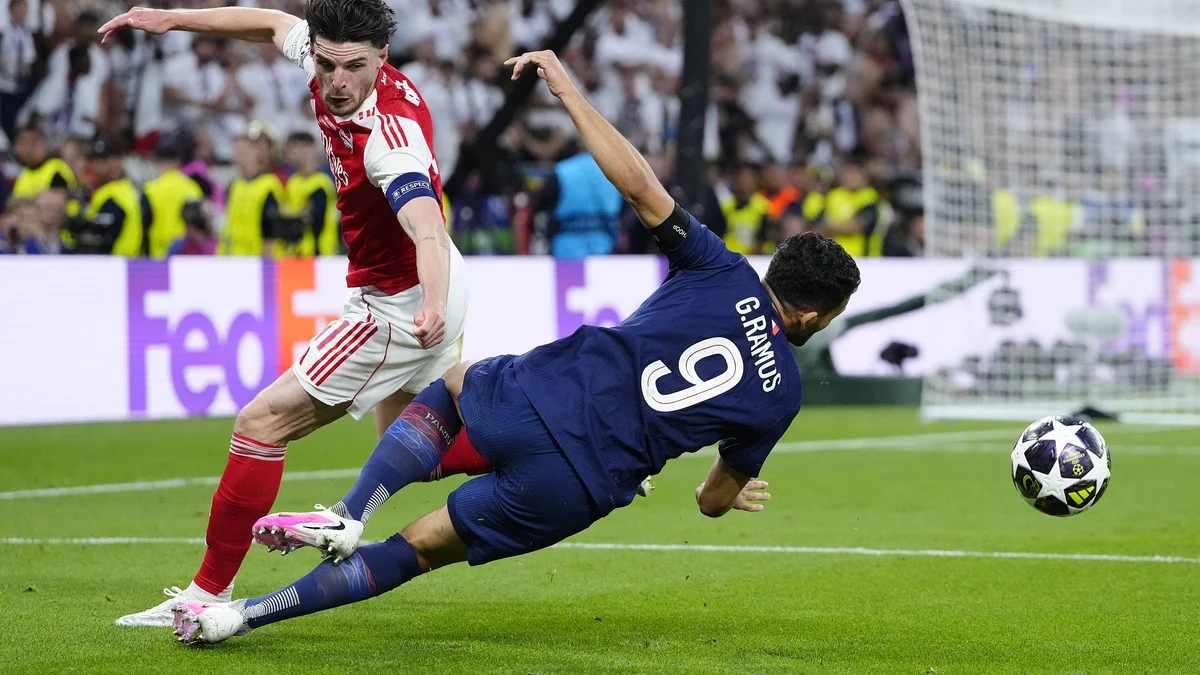
PSG's Gonzalo Ramos and Arsenal's Declan Rice battle for the ball in the Champions League Final. Anadolu Agency/IMAGO
Anadolu Agency/IMAGOThis article was generated with the help of AI. Learn more.